Why Serious Home Cooks Are Swapping Their Food Processors for This Ancient Chettinad Tool
The Gadget Drawer Problem
Most American kitchens have one. That drawer — or cabinet — stuffed with appliances that promised to change everything. The mandoline you're scared of. The immersion blender that works great until it doesn't. And the food processor, that hulking workhorse that technically does the job but somehow never quite delivers the results the recipe promised.
Here's the thing nobody tells you: for certain tasks, especially when you're cooking Chettinad food, the food processor is actually working against you. The high-speed blade creates friction heat. It chops rather than crushes. It aerates ingredients that should stay dense and paste-like. And the result? A curry base that tastes competent but never quite reaches that deep, layered complexity you get at a great South Indian restaurant.
The fix isn't a better food processor. It's a completely different approach — one that Chettinad cooks have been using for generations.
Meet the Ammi Kallu: The Original Flavor Machine
The ammi kallu is a traditional South Indian grinding stone — a heavy granite slab paired with a cylindrical rolling stone. It looks almost absurdly simple. Two pieces of rock. No motor, no settings, no warranty card.
But the physics of what happens when you grind on an ammi kallu are genuinely different from what a food processor does. Instead of cutting ingredients into smaller pieces, the stone crushes and smears them. Cell walls break down more completely. Oils release from spices at a slower rate, which means they integrate into the paste rather than sitting on top of it. The result is a texture that's simultaneously smoother and more cohesive — a paste that behaves differently when it hits a hot pan.
Chettinad cooks will tell you that a coconut-based curry paste ground on stone tastes noticeably different from one blended in a machine. This isn't nostalgia talking. The grinding action emulsifies the coconut's natural fats directly into the spice mixture in a way that blending simply can't replicate.
The Ural and Ulakkai: For Spices That Deserve Better
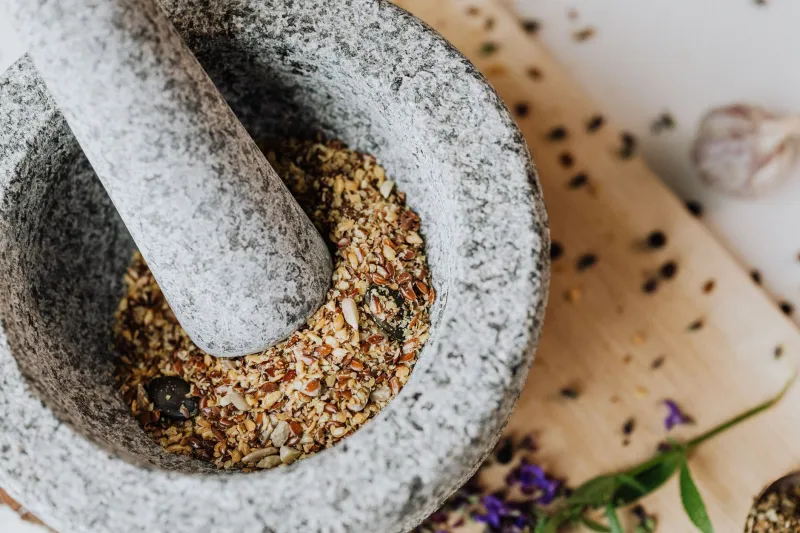
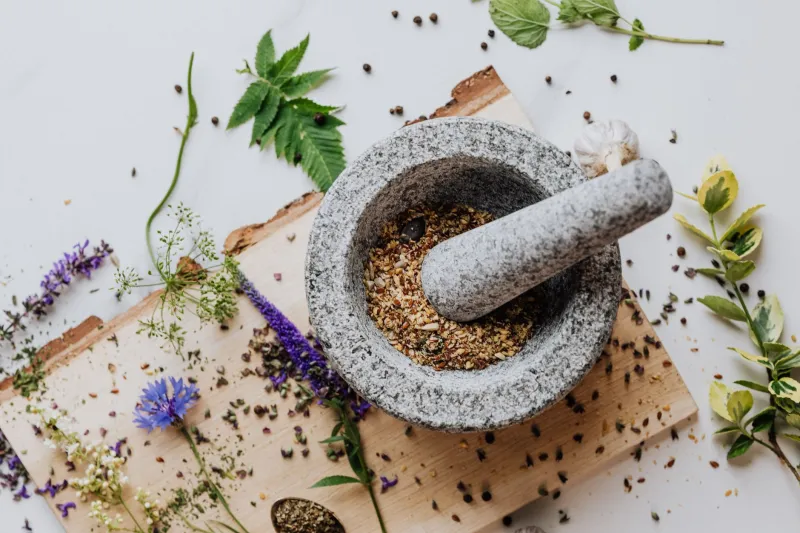
Another essential from the traditional Chettinad kitchen is the ural (mortar) and ulakkai (pestle) — a heavy stone set that's used specifically for whole spices, fresh aromatics, and small-batch grinding tasks.
Yes, you have a mortar and pestle. But if it's the marble or ceramic kind you picked up at a kitchen store, it's probably not doing what a proper stone ural does. The rough, porous surface of a traditional granite mortar actually grips spice particles and pulls them apart rather than just bouncing them around. Cardamom pods crushed in a stone ural release their volatile oils immediately and completely. Dried red chilies ground this way produce a powder with a different texture than pre-ground versions — coarser in some places, almost floury in others — which changes how they behave in a curry.
For tasks like making a quick tempering spice mix, bruising fresh ginger and garlic together, or cracking whole peppercorns before blooming them in oil, a good stone ural is faster and more effective than pulling out the food processor and then cleaning it afterward.
When to Use What: A Practical Breakdown
This isn't about being a purist. Your food processor has a place. Here's how to think about when each tool actually earns its spot on the counter:
Use the ammi kallu or a wet grinder for:
- Coconut-based curry pastes and chutneys
- Idli and dosa batters (fermentation works better with stone-ground batter)
- Large-batch spice pastes that need a smooth, emulsified consistency
- Anything where you want oils fully integrated rather than separated
Use the stone mortar and pestle for:
- Whole spice combinations before tempering
- Small amounts of fresh aromatics (ginger, garlic, green chili)
- Dry spice blends where you want texture variation
- Anything you're making in quantities under about half a cup
Use your food processor for:
- Chopping onions in bulk for a large batch of curry base
- Rough-chopping tomatoes or other vegetables
- Tasks where texture precision isn't critical
- Anything time-sensitive where "good enough" genuinely is good enough
The Wet Grinder: A Middle Ground Worth Knowing
If the ammi kallu feels like a commitment (and honestly, it is — those things are heavy), a tabletop wet grinder is a practical middle path that's popular in South Indian households across the US. These electric appliances use stone rollers instead of blades, which means you get the crushing action of traditional stone grinding without the workout.
For making dosa batter, grinding soaked lentils, or producing smooth coconut pastes in larger quantities, a wet grinder is genuinely superior to a food processor and a worthwhile investment if you're cooking South Indian food more than occasionally. Brands like Elgi Ultra and Butterfly are well-regarded in the South Indian community and available through Indian grocery retailers and specialty online stores — including right here at Chettinad Shop.
Where to Find These Tools in the US
This is the question most American home cooks get stuck on. Traditional Chettinad kitchen tools aren't at Williams Sonoma. But they're more accessible than you might think.
Indian grocery stores in larger cities often carry stone mortar and pestle sets, and some stock small wet grinders. Online, you have more options — look for granite ural sets specifically, since the material matters. Wet grinders from South Indian manufacturers are available through specialty importers.
At Chettinad Shop, we've made it a point to source traditional tools that are actually made to the standards Chettinad cooks expect — not decorative versions that look the part but don't perform. If you're serious about getting authentic results in your American kitchen, starting with the right equipment is half the battle.
The Investment Argument
A good granite mortar and pestle costs somewhere between $30 and $80 depending on size. A quality wet grinder runs $150 to $300. Neither of those numbers is trivial, but consider the math differently: these tools don't break, don't need replacement parts, and don't become obsolete when a new model drops. The ammi kallu your grandmother used is probably still functional today.
More practically, if you've ever spent $25 on a jar of specialty curry paste that still didn't taste quite right, you already know that shortcuts have their own costs. The traditional tools exist because they produce results that other methods can't fully replicate — and once you've tasted the difference in your own kitchen, the investment starts looking pretty reasonable.
Your food processor isn't going anywhere. But it might start spending a lot more time in the cabinet.