The Stone Grinder That Serious Cooks Swear By (And Why It Leaves Every Jar of Curry Paste in the Dust)
Walk into any traditional Chettinad home in the Sivaganga district of Tamil Nadu, and you'll notice something that's conspicuously absent from most American kitchens: a heavy, low-slung stone grinder sitting near the prep area like it owns the place. It's not decorative. It's not a relic. It's the single most important piece of equipment in one of the world's most complex spice-driven cuisines — and somehow, it never made the journey West.
That's starting to change. A growing number of South Indian home cooks across the US are rediscovering the wet grinder (called an ammi kallu in Tamil when referring to the traditional stone version), and the results are converting even the most skeptical American food nerds. If you've ever made a Chettinad curry from scratch and felt like something was just slightly off — a little gritty, a little flat, missing that haunting depth you get at a great South Indian restaurant — there's a very good chance this is the tool you've been missing.
What Exactly Is a Wet Grinder?
At its core, a wet grinder uses two heavy granite or basalt stones — one stationary, one rotating — to crush and grind soaked ingredients into an ultra-smooth paste. The modern electric version is a countertop appliance roughly the size of a bread machine. The traditional hand-operated stone version (ammi) is essentially a flat granite slab with a cylindrical roller that you push back and forth by hand.
Both work on the same principle: slow, grinding pressure applied with stone on stone, which releases oils, breaks down cell walls, and creates an emulsified paste with a texture and flavor profile that no blender or food processor can replicate. The key word there is slow. A blender chops. A food processor shreds. A wet grinder transforms.
For Chettinad cooking specifically, this distinction matters enormously. The cuisine is built on freshly ground spice pastes — combinations of roasted kalpasi (stone flower), marathi mokku (dried flower pods), whole peppercorns, dried red chilies, and a dozen other aromatics that need to be ground together into a cohesive, intensely flavored base. When you grind these in a blender, you get a chunky, slightly separated mixture. When you grind them on stone, you get something silky and unified, where every element has merged into a single, complex flavor compound.
Why Did This Tool Disappear from Western Kitchens?
The short answer: it never arrived in the first place. When South Indian immigrants began settling in the US in larger numbers after the 1965 Immigration Act, they were navigating a food landscape that was already stacked against traditional cooking. Ingredients were hard to source. Kitchen spaces were different. And American food culture in the 1970s and 80s was firmly in the blender-and-food-processor era — convenience was the whole point.
The traditional ammi kallu was heavy, labor-intensive, and required a technique that took years to develop. It made sense to leave it behind. Electric wet grinders were available in India, but importing large appliances was complicated and expensive. So generations of South Indian cooks in America adapted. They used blenders. They used food processors. They bought pre-made pastes. And slowly, the knowledge of what stone grinding actually does to spices faded into the background.
The jarred curry paste industry, meanwhile, was happy to fill that gap. But anyone who's cooked seriously with both knows the difference is not subtle.
What Stone Grinding Actually Does to Your Spices
Here's the food science part, and it's worth paying attention to. When spices are ground slowly between two stone surfaces with a small amount of liquid added (water, coconut milk, or oil, depending on the recipe), several things happen simultaneously.
First, the essential oils in the spices are released gradually and evenly, rather than being volatilized by the heat generated in a high-speed blender. This means you retain more of the aromatic compounds that make Chettinad food smell the way it does — warm, layered, almost floral in places.
Second, the slow grinding creates an emulsification effect. The starch, fiber, and oils in the spices bind together in a way that simply doesn't happen with mechanical chopping. The result is a paste that holds together during cooking, coats proteins and vegetables evenly, and doesn't separate into an oily mess when it hits a hot pan.
Third — and this is the one that's hardest to explain but easiest to taste — stone-ground pastes have a roundness to them. The harsh edges of individual spices get smoothed out. The bitterness of raw fenugreek, the sharpness of dried chilies, the resinous punch of kalpasi — all of it integrates into something coherent and deeply savory rather than just loud.
Getting Started Without Buying a Countertop Appliance
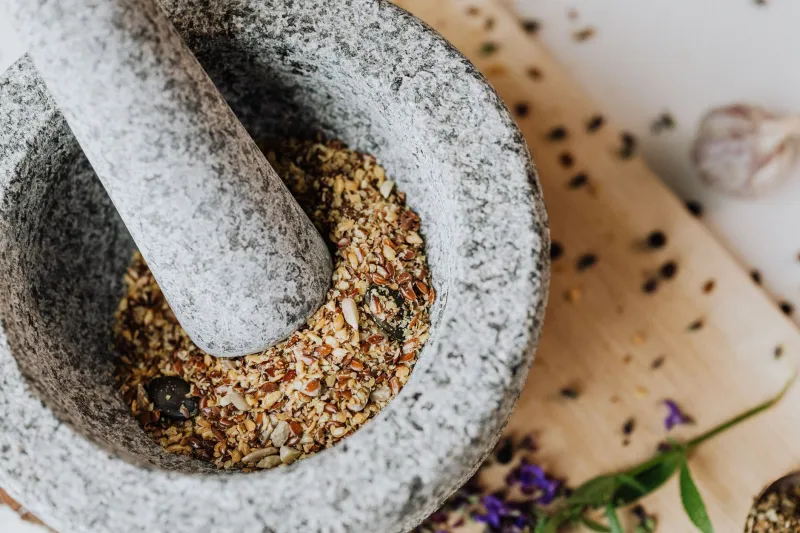
If you're not ready to invest in an electric wet grinder (though models designed for home use are now widely available online for $100–$200 and are genuinely worth it), you can approximate the technique using a heavy granite mortar and pestle. The key is patience and the addition of small amounts of liquid as you grind.
Start with your dry-roasted whole spices. Let them cool completely. Add a tablespoon of water and begin grinding in slow, circular motions, pressing down firmly rather than just crushing. Add liquid in small increments. Expect to spend 10–15 minutes on a proper paste — this is not a quick process, and that's entirely the point.
The difference between a 90-second blender paste and a 12-minute mortar paste is noticeable in the finished dish. It's the difference between a curry that tastes like a collection of spices and one that tastes like a single, unified thing.
Pairing the Right Spices with the Right Technique
The wet grinder really shines when you're working with the more unusual Chettinad aromatics — the ones that are hard to find at a typical grocery store but make all the difference in authenticity. Stone flower (kalpasi), star anise, whole mace, and dried kapok buds all have complex, layered flavor profiles that benefit enormously from slow grinding. These aren't spices that give up their best qualities easily; they need time and pressure to open up.
If you're sourcing these ingredients online — which, let's be honest, is how most of us in the US do it — look for whole, unprocessed versions rather than pre-ground powders. The whole spices will keep their potency longer, and they're what the wet grinder was designed for.
The Bigger Picture
Rediscovering the wet grinder isn't just about getting a better curry paste. It's about understanding why Chettinad food tastes the way it does — and realizing that the technique and the tool are inseparable from the flavor. Every shortcut in the process takes you one step further from the real thing.
The good news is that this particular shortcut is easy to walk back. The tool exists, it's accessible, and the learning curve is shorter than you'd expect. Your first stone-ground paste will taste better than anything that came out of a jar. Your fifth will make you wonder why you ever bothered with a blender for this kind of cooking.
Some kitchen wisdom skips a generation. This one is worth going back to find.