Spices That Crossed Oceans: How Chettinad's Trading Past Shapes What You Cook Tonight
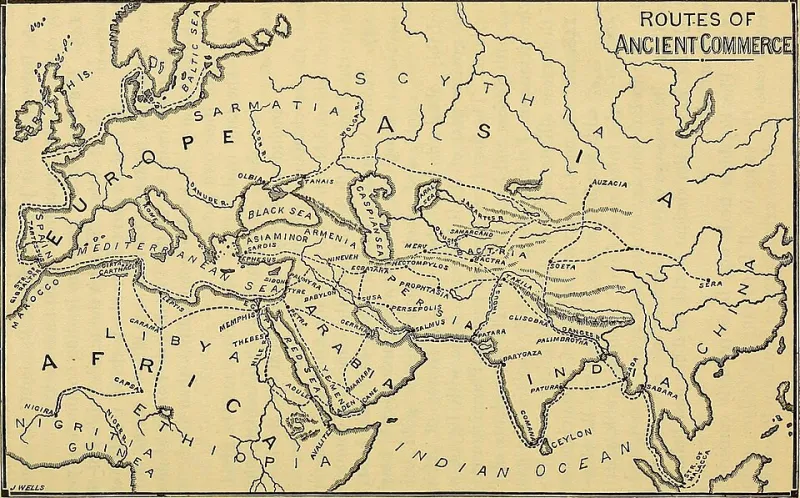
Photo: Internet Archive Book Images, No restrictions, via Wikimedia Commons
Pull open a bag of kalpasi — that strange, bark-like spice that looks like it belongs in a terrarium — and you're holding a small piece of a trading empire that peaked two centuries ago. Most people in the US have never heard of kalpasi. Fewer still know that it ended up in Chettinad kitchens because of merchant families who sailed to Burma, Sri Lanka, and the Malay Peninsula before your great-great-grandparents were born. That history isn't trivia. It's the reason Chettinad food tastes the way it does — and it has real, practical implications for how you stock your pantry right now.
Who Were the Chettinad Merchants, Exactly?
The Nattukotai Chettiars — the community at the center of Chettinad culture — were, first and foremost, traders and financiers. Based in the Sivaganga district of what is now Tamil Nadu, they built a commercial network that stretched across Southeast Asia from roughly the mid-1800s through the mid-1900s. They financed infrastructure in Burma, ran banks in Ceylon, and maintained business outposts in Singapore, Malaysia, and Vietnam.
Here's the part that matters for your kitchen: they didn't just move money. They moved goods. And when they came home, they brought ingredients with them.
Spices and aromatics that weren't native to Tamil Nadu gradually found their way into Chettinad cooking through these trade connections. Star anise, which has a stronger foothold in Chettinad cuisine than in most other South Indian regional traditions, likely arrived via trade links with Chinese merchants operating across the same Southeast Asian ports. Kalpasi (stone flower, a type of lichen) was prized along these routes for its earthy, mossy depth. Marathi mokku — dried flower pods that add a subtle bitterness — became a signature Chettinad ingredient precisely because the merchant community had the access and the appetite for unusual aromatics.
A Cuisine Built on Cosmopolitan Sourcing
This is what separates Chettinad spice logic from the rest of South Indian cooking. Most regional Indian cuisines developed their flavor profiles based on what grew locally or what was available through relatively short-distance trade. Chettinad cooks had a different supply chain entirely — one that was international by design.
The result is a spice cabinet that reads almost like a tour of the Indian Ocean trading world. You'll find ingredients with roots in South India sitting alongside those with clear connections to Southeast Asia, the Arab spice trade, and even colonial-era exchanges. Chettinad pepper chicken, for instance, relies on a layered spice paste that would feel at home in both a Tamil village kitchen and a Malay hawker stall — because, in a very real historical sense, it has roots in both places.
What the merchants brought back, their wives and cooks incorporated. And because the Chettiar community was wealthy and cosmopolitan, there was both the budget and the curiosity to keep experimenting. Over generations, these imported ingredients stopped feeling foreign and became essential. Today, a Chettinad curry without kalpasi or marathi mokku isn't wrong, exactly — it's just incomplete.
Why This Matters When You're Shopping in the US
Here's where history connects to your actual grocery run.
Because Chettinad cuisine evolved through a trading culture, many of its most distinctive spices were always specialty items — not the kind of thing you'd find at every corner market, even in India. That means the sourcing challenge American home cooks face today isn't entirely new. Chettinad cooks have always had to be deliberate about where they get their ingredients.
The good news is that the same globalized trade infrastructure that the Chettiar merchants helped build centuries ago is precisely what makes it possible for you to order authentic kalpasi, marathi mokku, or stone-ground Chettinad spice blends from your couch in Ohio or Oregon. The supply chains are different now, but the underlying logic — that these flavors require intentional sourcing — is the same.
When you're building out your Chettinad pantry, it helps to think in terms of tiers. Some spices are load-bearing: black pepper, dried red chilies, coriander, cumin. These are non-negotiable and easy to find almost anywhere in the US. Then there's the second tier — the ingredients that are harder to source locally but make an outsized flavor difference: kalpasi, marathi mokku, star anise in the right form, good-quality dried vetiver root. These are the ones worth seeking out from a specialty retailer who actually understands Chettinad cooking, because a generic "Indian spice" version often won't cut it.
The Ingredient That Tells the Whole Story
If you want a single ingredient that encapsulates the Chettinad merchant story, it's kalpasi. This dried lichen — sometimes called stone flower or dagad phool — has almost no presence in other South Indian cuisines. It's not flashy. It doesn't smell like much on its own. But drop it into hot oil at the start of a biryani or a meat curry, and it releases this low, forest-floor depth that you genuinely cannot replicate with anything else.
Kalpasi made it into Chettinad kitchens because merchants were traveling through regions where it was traded and valued, brought it home, and someone decided to see what it could do. That's the Chettinad culinary story in miniature: curiosity, access, and a willingness to incorporate the unfamiliar until it becomes indispensable.
Cooking With History on Your Side
There's something kind of remarkable about the fact that a spice route mapped out by Tamil merchants in the 1800s still has a direct line to what lands on your dinner table in 2024. But that's exactly what's happening every time you cook an authentic Chettinad dish.
Understanding this history changes how you approach the cuisine. Instead of treating Chettinad spices as an exotic checklist, you start to see them as ingredients with intention — things that ended up in this food for real reasons, through real human effort, across real distances. That reframe makes you a more thoughtful cook. It also makes the food taste better, because you stop substituting and start sourcing.
The merchants are long gone, but their pantry logic lives on. Stock it right, and every meal you cook carries a little of that history forward.